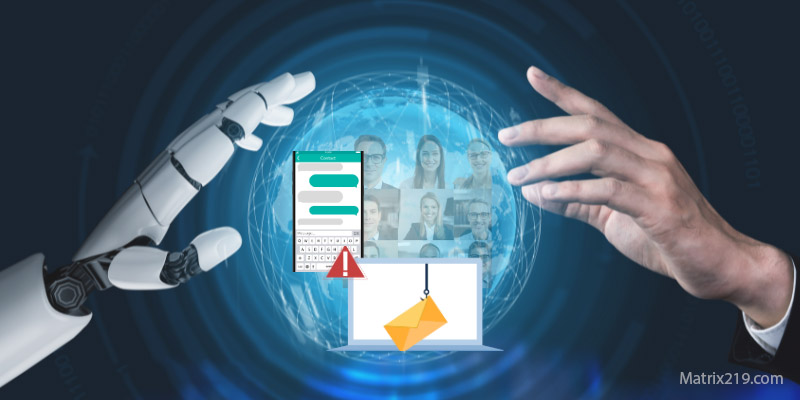
AI vs humans in social engineering has become a defining question in modern cybersecurity. As artificial intelligence enables attackers to scale manipulation, personalize messages, and automate deception, many wonder whether human judgment can still compete with machine-driven persuasion.
This article examines the strengths and limits of AI and humans in social engineering, how each side influences the outcome of attacks, and why this is not a simple battle of technology versus people—but a shifting balance between automation and decision-making.
Quick Navigation
Understanding the Social Engineering Battlefield
Social engineering is not about breaking systems. It is about influencing choices.
On this battlefield:
-
AI provides speed, scale, and consistency
-
Humans provide judgment, context, and ethics
The outcome depends on how these forces interact.
What AI Brings to Social Engineering Attacks
AI enhances attacker capabilities by removing traditional constraints.
Attackers use AI to:
-
Generate realistic messages instantly
-
Personalize content using data at scale
-
Adapt tone and timing dynamically
These capabilities reflect trends discussed in How AI Is Transforming Social Engineering Attacks and explain why attack volume and quality have increased together.
Human Strengths That AI Cannot Fully Replace
Despite AI’s advantages, humans retain critical strengths.
Humans can:
-
Detect contextual inconsistencies
-
Apply ethical judgment
-
Pause and verify under uncertainty
-
Recognize when something “feels off”
These abilities remain difficult to automate reliably.
Why AI Often Wins the First Interaction
AI excels at initiating engagement.
It wins early because it:
-
Responds instantly
-
Never tires or hesitates
-
Maintains conversational consistency
-
Feels neutral and professional
This gives attackers an advantage during first contact, before skepticism activates.
Why Humans Still Decide the Final Outcome
Even in AI-driven attacks, humans often make the final decision.
Outcomes depend on whether a person:
-
Verifies a request
-
Questions urgency
-
Follows established procedures
This is why human behavior remains central, as explained in Why Humans Are the Weakest Link in Cybersecurity —not because people are flawed, but because they are the decision point.
How AI Exploits Human Cognitive Shortcuts
AI does not overpower logic; it exploits shortcuts.
Common targets include:
-
Trust in familiarity
-
Obedience to authority
-
Desire to resolve issues quickly
-
Cognitive fatigue
These patterns are rooted in psychology rather than technology, as explored in The Psychology Behind Social Engineering Attacks
Detection Tools Favor Machines, Decisions Favor Humans
Security tools increasingly rely on AI to detect threats, yet:
-
Tools flag patterns
-
Humans interpret intent
-
Tools reduce noise
-
Humans confirm legitimacy
This division explains the limits outlined in Phishing Detection Tools Compared and why automation alone cannot “win” the war.

Phishing Detection Tools Compared
When Humans Lose Against AI-Driven Manipulation
Humans are more likely to lose when:
-
Processes are unclear
-
Urgency overrides verification
-
Workloads are high
-
Communication channels are informal
In these conditions, AI-powered manipulation gains momentum.
When Humans Outperform AI Attacks
Humans regain advantage when:
-
Verification is mandatory
-
Authority does not override process
-
Decisions require multiple confirmations
-
Awareness includes modern attack techniques
Process design, not intuition, shifts the balance.
The Real Winner: Process Over Intelligence
The social engineering war is not truly AI vs humans.
The real winner is:
-
Well-designed process over improvisation
-
Verification over trust
-
Structure over speed
AI amplifies manipulation, but strong processes neutralize its impact.
External Perspective on AI and Human Decision-Making
Cybersecurity research increasingly emphasizes that AI reshapes attack delivery, not decision authority, as reflected in NIST Human-Centered Cybersecurity Guidance
Frequently Asked Questions (FAQ)
Is AI better at social engineering than humans?
AI is better at scale and speed, not judgment.
Can humans still stop AI-driven attacks?
Yes, especially through verification and process controls.
Does AI remove the need for human attackers?
No. Humans still guide strategy and objectives.
Are AI attacks unstoppable?
No. They are powerful but limited by human decisions.
What matters more than intelligence in defense?
Process design and consistent verification.
Conclusion
AI vs humans in social engineering is not a zero-sum conflict. AI dominates the delivery of manipulation, but humans still control outcomes through decisions, verification, and process discipline.
As AI continues to evolve, the balance will favor those who design systems that assume manipulation—not perfect judgment. In the social engineering war, awareness and structure matter more than intelligence alone.