The psychology behind social engineering attacks explains why these attacks succeed even against well-trained users and secure organizations. While technical defenses continue to improve, attackers increasingly rely on psychological manipulation to bypass security by influencing how people think, feel, and decide.
Social engineering works because it exploits predictable cognitive patterns. Attackers understand how stress, authority, trust, and urgency affect human judgment, and they design scenarios that trigger automatic responses rather than rational evaluation. This article breaks down the psychological principles behind social engineering attacks and explains how attackers weaponize human behavior.
Quick Navigation
Why Psychology Is Central to Social Engineering
Social engineering is not a technical problem—it is a behavioral one.
Attackers focus on:
-
Emotional reactions instead of logic
-
Habitual responses instead of analysis
-
Social norms instead of security rules
This human-centered approach is why social engineering consistently outperforms purely technical attacks, as explained in Why Social Engineering Attacks Are More Effective Than Malware
Cognitive Biases Exploited in Social Engineering
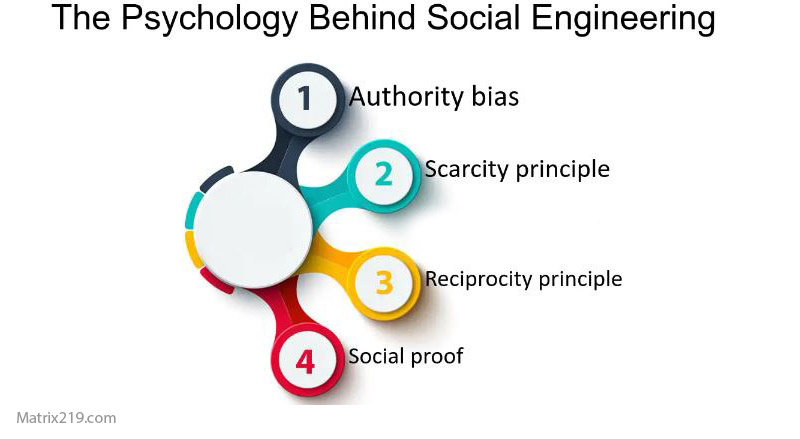
Authority Bias
People are more likely to comply with requests from perceived authority figures. Attackers exploit this by impersonating:
-
Executives
-
IT administrators
-
Law enforcement
-
Trusted institutions
This tactic is commonly seen in attacks analyzed in Social Engineering Attacks Explained for Non-Technical Users
Urgency Bias
Urgency short-circuits rational thinking.
Messages that imply:
-
Immediate action required
-
Consequences for delay
-
Limited time windows
Push victims to act before verifying legitimacy. Urgency is one of the strongest drivers in successful social engineering.
Fear and Threat Avoidance
Fear-based manipulation triggers compliance by presenting:
-
Account suspension warnings
-
Security breach alerts
-
Financial loss threats
When fear is activated, people prioritize relief over caution.
Reciprocity and Helpfulness
Humans are socially conditioned to help others.
Attackers exploit this by:
-
Asking for small favors
-
Framing requests as assistance
-
Creating obligation
Once trust is established, larger requests follow.
Trust as an Attack Surface
Trust is a fundamental requirement for social interaction—but also a vulnerability.
Attackers build trust by:
-
Mimicking familiar communication styles
-
Referencing real organizational details
-
Using insider terminology
This reinforces why social engineering targets humans rather than systems, a distinction clarified in What Is Social Engineering in Cybersecurity? (Updated Definition)
Habit and Routine Exploitation
Routine behaviors reduce cognitive load but increase risk.
Examples include:
-
Automatically approving requests
-
Clicking familiar-looking links
-
Following standard workflows
Attackers design attacks to blend into routine activity, avoiding suspicion.
Emotional Manipulation Over Technical Skill
Most successful social engineering attacks require minimal technical skill but deep psychological insight.
Attackers rely on:
-
Emotional timing
-
Contextual awareness
-
Behavioral predictability
This is why even experienced professionals fall victim under the right conditions.
Why Training Alone Is Not Enough
Awareness training improves recognition, but it does not eliminate cognitive bias.
Under pressure:
-
Training is overridden by instinct
-
Stress reduces memory recall
-
Familiar patterns dominate behavior
This limitation explains why humans are often labeled the weakest link, as discussed in Why Humans Are the Weakest Link in Cybersecurity
Psychological Triggers in Modern Digital Environments
Remote work, constant notifications, and digital overload amplify risk by:
-
Increasing distraction
-
Reducing verification time
-
Normalizing urgent digital requests
These conditions make psychological manipulation even more effective.
psychology behind social engineering attacks
External Research on Human Manipulation
Behavioral science research consistently shows that humans rely on heuristics and emotional shortcuts when making decisions, a foundation that attackers exploit, as outlined in Cialdini Principles of Influence
Frequently Asked Questions (FAQ)
Why do smart people fall for social engineering attacks?
Because intelligence does not eliminate cognitive bias. Under pressure, emotional responses override rational analysis.
Is social engineering manipulation intentional?
Yes. Attackers deliberately design scenarios to trigger specific psychological responses.
Which emotion is most exploited in social engineering?
Urgency is the most common, followed by fear and trust in authority.
Can understanding psychology reduce social engineering risk?
Yes. Awareness of psychological triggers improves resistance, especially when combined with clear procedures.
Are psychological attacks increasing?
Yes. As technical defenses improve, attackers increasingly focus on human behavior.
Conclusion
The psychology behind social engineering attacks explains why these threats remain effective despite advanced security technology. By exploiting cognitive biases, emotional responses, and social norms, attackers bypass defenses without touching code.
Recognizing the psychological mechanisms behind social engineering is essential for reducing risk. Security awareness must evolve beyond rules and tools to address how humans actually think and behave under pressure.