
Digital Privacy and Online Tracking have become inseparable from modern internet use. Every search you perform, website you visit, or application you install generates data signals that describe your behavior, preferences, and habits. Most of this data collection happens silently, without explicit awareness of who is collecting the information, how long it is stored, or where it eventually ends up.
Online tracking today is no longer limited to advertising optimization. It plays a role in behavioral profiling, content personalization, risk scoring, and decision shaping across digital platforms. Many users rely on tools such as incognito mode or VPNs believing they provide full protection, but these solutions only address specific layers of a much larger system.
This guide explains how online tracking actually works, what digital privacy realistically means in 2026, and how individuals can reduce unnecessary exposure. The goal is not to promise complete anonymity, but to provide clarity, context, and practical control over your digital footprint.
Quick Navigation
What Digital Privacy Means in Practice
Digital privacy is not about disappearing from the internet. It refers to controlling how personal data is collected, processed, shared, and retained. In modern digital systems, privacy exists on a spectrum rather than as a fixed state.
Most online services depend on data-driven business models. User activity is analyzed to improve functionality, personalize experiences, and generate revenue. Understanding this reality is critical, because privacy protection focuses on limiting excessive data collection rather than eliminating it entirely.
How Online Tracking Systems Work
Online tracking relies on multiple overlapping mechanisms that operate simultaneously. These systems are designed to recognize users across sessions, devices, and platforms, often without direct identification.
Cookies and Persistent Identifiers
Cookies store identifiers inside the browser to recognize returning users. While some cookies expire quickly, others persist for extended periods and enable long-term tracking across browsing sessions. Persistent identifiers can survive browser restarts and continue tracking behavior over time.
For a deeper breakdown of tracking methods used by websites, see: How Websites Track You.
Browser Fingerprinting
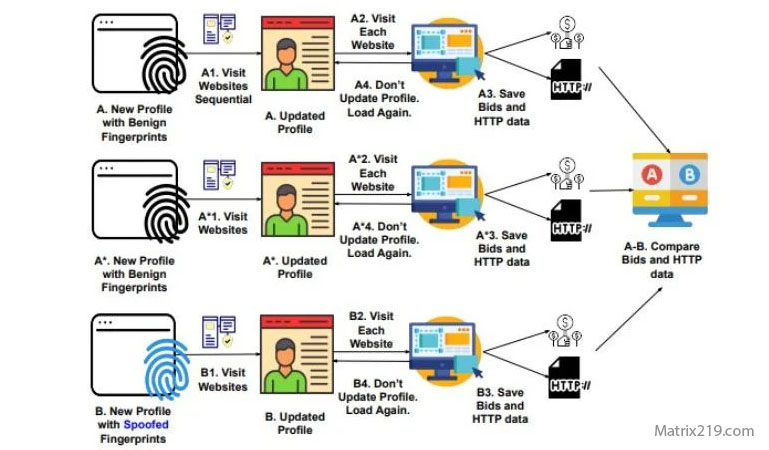
Browser fingerprinting does not rely on stored files. Instead, it analyzes technical characteristics such as screen resolution, installed fonts, operating system details, and browser configuration. When combined, these signals can uniquely identify a device even after cookies are cleared.
A detailed explanation of this technique is covered here: Browser Fingerprinting Explained
Account-Based Tracking
When users log into online accounts, tracking becomes directly linked to identity. Activity across devices and services can be merged into a single behavioral profile, enabling cross-platform tracking even outside the original website.
Who Is Collecting Your Data
Tracking is rarely limited to one entity. During a single online interaction, multiple parties may collect data simultaneously. Advertisers analyze behavior for targeting, while analytics providers focus on performance measurement and optimization.
Data brokers aggregate information from multiple sources to create long-term user profiles. These profiles may persist even after accounts are deleted, making data control more complex than most users expect.
To understand how third parties participate in tracking ecosystems, see: Who Collects Your Data Online
Online Tracking Beyond Websites
Tracking extends far beyond traditional web browsing. Mobile applications collect device identifiers, usage patterns, and behavioral signals, often continuously in the background. Smart devices transmit telemetry data related to usage, location, and system status.
Email tracking pixels confirm when messages are opened, while location data can sometimes be inferred without direct access to GPS. These methods expand tracking into areas users rarely associate with privacy risks.
A full breakdown of non-browser tracking methods is explained here: Online Tracking Beyond Websites
Online Tracking Beyond Websites
Common Misconceptions About Digital Privacy
Many popular assumptions about privacy are inaccurate. Incognito mode only prevents local browsing history from being saved and does not block external tracking. VPNs hide IP addresses but do not prevent fingerprinting or account-based data collection.
Privacy settings can reduce exposure, but they do not eliminate data collection entirely. Effective privacy protection begins with understanding system limitations rather than relying on single tools.
Practical Ways to Reduce Online Tracking
While complete avoidance is unrealistic, meaningful reduction is achievable through layered strategies. Using privacy-focused browsers, limiting unnecessary account logins, and reviewing app permissions can significantly reduce tracking exposure.
Managing permissions at the application level is especially important on mobile devices. Many tracking mechanisms rely on excessive or unnecessary access.
A practical guide to limiting app-level tracking can be found here: How Apps Track You
For step-by-step actions to reduce tracking across platforms, see: How to Stop Online Tracking
The Role of Privacy Laws and Regulations
Privacy regulations establish minimum standards for transparency and data handling. Laws such as GDPR improve user rights, but they do not guarantee full protection. Enforcement varies by region, and compliance does not automatically prevent tracking.
Users remain responsible for understanding how platforms operate and adjusting their behavior accordingly. Electronic Frontier Foundation – Online Privacy
FAQ
What is online tracking in simple terms?
Online tracking is the collection of data about your activity across websites, apps, and devices to identify behavior patterns or associate actions with specific users.
Can you browse the internet without being tracked?
Complete avoidance is extremely difficult. However, combining privacy-aware tools with informed browsing habits can significantly reduce tracking.
Does incognito mode protect digital privacy?
No. Incognito mode only prevents local history storage and does not stop websites, advertisers, or internet providers from collecting data.
Are free apps more risky for privacy?
Many free apps depend on data collection for revenue, which often results in broader tracking and third-party data sharing.
Is digital privacy the same as cybersecurity?
No. Cybersecurity focuses on protecting systems from attacks, while digital privacy focuses on how data is collected, used, and shared.